




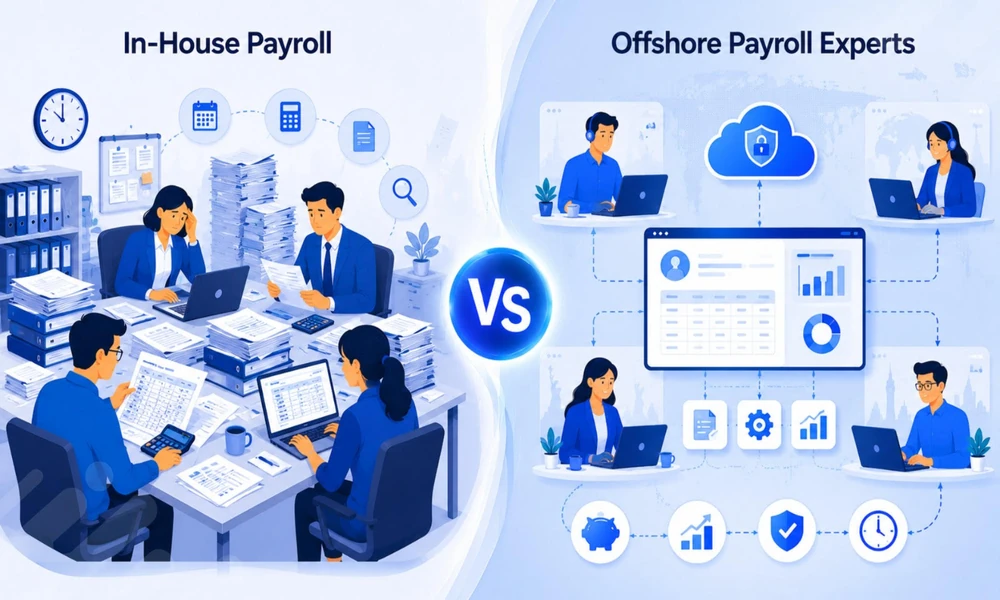
Payroll does not fail dramatically. It fails quietly, a missed deduction here, a delayed filing there, a process that works perfectly until the person who built it leaves. Most businesses do not discover their payroll setup has outgrown them during a routine month. They discover it during the wrong one.
The wrong month looks different for every business. For some, it is a regulatory change that slipped through because no one was tracking it. For others, it is a key employee resignation that reveals how much payroll knowledge is held by one person rather than by the organisation. For a few, it is a penalty notice that arrives long after the original oversight, by which point the cost is no longer just financial.
What these situations share is not carelessness. Most businesses running payroll in-house are doing so diligently, with the tools and people they have. The issue is structural. An in-house payroll function that was built for twenty employees, one office and a straightforward benefits structure does not automatically evolve when the business does. It continues quietly until it cannot.
The question of whether to keep payroll in-house or move it to offshore experts is not really a question about cost savings. It is a question about what your business can afford to get wrong.
Why Payroll Is Never Just a Monthly Task
Here is something that rarely appears in a cost comparison spreadsheet. Payroll is not a once-a-month activity. It is a continuous compliance obligation.
Between tracking attendance, managing variable pay, filing statutory returns, and staying current with labour regulations, the time investment is far greater than most businesses account for. The visible cost is the salary of the person running it. The invisible cost is everything else hours pulled from core operations, risk carried when something is miscalculated and institutional knowledge that walks out the door if that one payroll-fluent employee leaves.
This is the reason behind the growing shift toward professional payroll management services. Businesses are not outsourcing payroll because they cannot do it. They are outsourcing it because doing it in-house carries a compounding cost that only becomes obvious after it has already grown too large.
What In-House Payroll Actually Involves And Where It Starts to Strain
Running payroll internally works well under certain conditions. A lean, consistent headcount. A single employment type. Limited statutory complexity. One jurisdiction.
When any of those variables change and for most businesses, they do the strain begins to show. Here is what the in-house model typically demands:
- Dedicated personnel with current working knowledge of labour laws, tax codes and statutory deductions
- Licensed payroll software with regular updates for compliance changes
- Internal audit protocols to catch errors before disbursement
- Manual overrides for exceptions: advances, deductions, allowances, retentions
- Time spent liaising with finance, HR and legal across every payroll cycle
For a small or mid-sized business, this is not just a department. It is a dependency. The moment that dependency is tested through team turnover, regulatory change or business expansion, the model reveals its limitations.
The Case for Offshore Payroll Services: What the Numbers Say (and What They Do Not)
The case for engaging an offshore payroll team is frequently framed in terms of cost reduction, and that framing, while accurate, can be reductive.
Yes, engaging an offshore payroll team typically reduces direct processing costs compared to maintaining a full-time in-house function. But the more meaningful advantage is access to specialised expertise at a scale that most businesses cannot justify building internally.
An offshore payroll team is not a generic outsourcing arrangement. At its best, it is a dedicated function staffed by professionals whose entire work is payroll compliance, people who track regulatory amendments, understand multi-jurisdiction filing requirements and bring institutional knowledge that does not leave when an employee resigns.
For businesses exploring payroll outsourcing for small businesses, this distinction matters considerably. A small business does not need a full payroll department. It needs payroll accuracy, compliance coverage, and the ability to scale all without the overhead of building that capability from scratch.
AI Can Process Payroll But It Cannot Own the Outcome
Payroll technology has advanced rapidly. Automated calculations, AI-assisted anomaly detection and smart integrations between HR platforms and accounting systems. These tools are genuinely useful and any credible payroll function today, whether in-house or outsourced, should be using them.
But there is a limit to what automation handles well. Payroll sits at the intersection of employment law, tax regulation, and employee trust, three domains where context, interpretation, and accountability matter as much as calculation speed.
When a statutory amendment changes how a particular deduction category is treated, an automated system updates the formula. A human expert understands the downstream implications: which employee categories are affected, what retroactive corrections may be required and how to communicate the change to affected staff. That interpretive layer is not a feature that gets added in the next software update.
The businesses that manage payroll best are not the ones that have replaced human judgment with AI. They are the ones who use intelligent tools to handle volume while retaining expert oversight to handle complexity.
What Is The Difference Between An Outsourced Payroll Function And Managing Payroll In-House?
Outsourced payroll services transfer the processing, compliance, and reporting functions to an external specialist provider. Unlike an in-house team, the provider maintains dedicated expertise across regulatory changes, handles multi-entity requirements and assumes accountability for accuracy and filing deadlines while the business retains oversight through structured reporting.
For decision-makers weighing both options, the question is less about control and more about where your internal capacity is best spent.
The Hidden Cost Nobody Budgets For
One of the clearest arguments for outsourced payroll rarely appears in a direct cost comparison: it is the cost of an error.
A miscalculated statutory deduction, a missed filing deadline, an incorrectly classified employment type, these carry penalty risk, audit exposure and in some cases, employee relations damage that is difficult to recover from. The businesses most exposed are not large corporations with layered compliance teams. They are mid-sized businesses that have grown beyond what their original payroll setup was designed to handle.
Professional payroll partners mitigate this risk not by guaranteeing perfection, but by building the checks, expertise and accountability that reduce the probability and impact of error.
What Sets Citadel Coworkers Apart in This Space
Businesses that move their payroll function to a dedicated offshore partner consistently report the same thing: the decision was easier than the transition and the transition was easier than they expected.
Citadel Coworkers has built its payroll offering around a straightforward principle that the businesses it serves should never have to think about payroll compliance unless they want to. The team operates as an extension of the client’s finance function, not as a vendor processing a ticket.
What that looks like in practice: structured payroll cycles with clear accountability, proactive updates when regulatory changes affect client-specific arrangements and reporting that is formatted for decision-making rather than data storage.
For growing businesses that need precision without the overhead of a full internal function, CCW offers a model that scales with the business rather than constraining it.
If your current payroll setup is one team member’s notice period away from a genuine crisis, it may be worth exploring what a professional offshore arrangement actually looks like in practice.
How to Evaluate Your Current Payroll Model Honestly
Before committing to either approach, it is worth asking a few questions that most cost comparisons overlook:
- If your current payroll person left tomorrow, how long would it take to fully replace their knowledge not just their role?
- Have you calculated the total cost of your in-house function, including software, compliance training, and the time cost to senior staff when issues escalate?
- Does your payroll setup scale cleanly with your business, or does each new hire, new entity, or new benefit structure create a proportional increase in processing complexity?
- When was the last time your payroll process was reviewed against current statutory requirements?
These are not rhetorical questions. They are the operational audit that most businesses never complete and the absence of that audit is precisely how payroll becomes a liability rather than a function.
The Forward View: Payroll as a Strategic Decision, Not a Back-Office Default
There is a version of this conversation that stays entirely in the realm of cost comparison salary costs versus service fees, control versus convenience. That version is useful, but it is not the whole picture.
The more important question is what your business does with the time, capital, and risk capacity that a well-managed payroll function returns to it. That is where the real value of a dedicated offshore payroll arrangement lies, not in the reduction of a line item, but in the reallocation of internal focus toward work that builds the business rather than maintains it.
Citadel Coworkers works with businesses that have made this reallocation deliberately, and consistently find that the clarity of a well-run payroll function has a quiet but meaningful effect on how the rest of the organisation operates. If you are at a point where the current setup feels like a ceiling rather than a foundation, the conversation about what comes next is worth starting.