




In modern industrial environments, operational efficiency is directly tied to the utilization rate of capital-intensive machinery. For operations managers, process engineers, and manufacturing decision-makers, idle machine time represents a silent drain on profitability. When a high-capacity CNC mill, injection molding press, or stamping machine sits stationary, the fixed costs associated with that asset continue to accrue, driving up the total cost per unit and compressing margins.
Minimizing these non-productive intervals requires a shift from manual, operator-dependent cycles to structured, automated workflows. By systematically addressing the friction points in part loading, unloading, and cycle transitions, enterprises can unlock hidden capacity within their existing shop floor footprint.
The Anatomy of Machine Idleness
To effectively eliminate downtime, variance must be removed from the production equation. In a conventional manufacturing setup, machine cycles are inherently bound to human availability. Human-dependent machine feeding introduces unpredictable micro-stoppages throughout a shift. These delays accumulate during operator breaks, shift changeovers, and periods of fatigue, leading to a fragmented production schedule.
Furthermore, manual material handling often results in suboptimal cycle pacing. An operator managing multiple stations may leave a machine cleared and waiting for several minutes while attending to a secondary task. This structural inefficiency is particularly pronounced in high-mix, low-volume production, where frequent changeovers demand continuous adjustments. To achieve a state of continuous processing, facilities must decouple the machine’s cycle time from the physical constraints of the workforce.
Streamlining Shop Floor Workflows
The transition to automated workflows begins with integrating smart material handling solutions directly into the machine’s communication interface. Utilizing discrete input/output signals or standardized industrial protocols, the manufacturing equipment and the automation system operate in a synchronized loop.
When a machine finishes a cycle, it transmits a “cycle complete” signal. This trigger instantly activates the handling system to clear the finished part and introduce raw stock. By neutralizing the latency between processing cycles, businesses can realize a predictable, deterministic throughput rate.
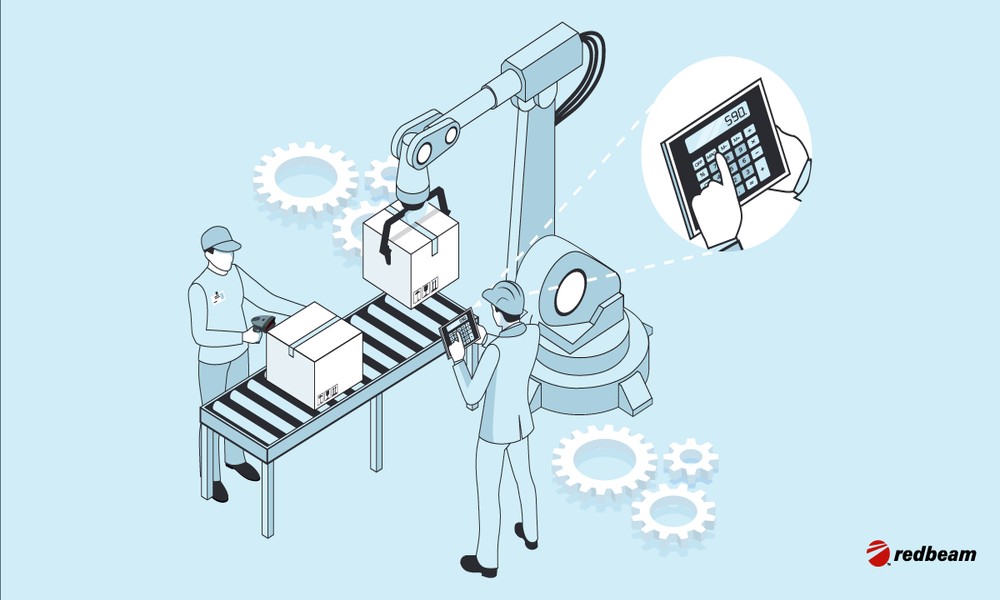
Implementing a dedicated machine tending robot within these cells ensures that part positioning remains precise and execution remains rapid. These systems execute repetitive tasks with absolute consistency, dropping loading times to a fixed number of seconds and eliminating the human-induced delays that typically erode daily output metrics.
Quantitative Impact on Operational Efficiency
The financial justification for upgrading to automated workflows is rooted in two critical metrics: Overall Equipment Effectiveness (OEE) and the amortization schedule of the machinery. OEE measures availability, performance, and quality. Manual part feeding inherently caps the availability score due to planned and unplanned human downtime.
| Operational Factor | Manual Tending | Automated Cell |
|---|---|---|
| Shift Availability | Variable (~75%) | Continuous (95%+) |
| Cycle Consistency | Subject to fatigue | Deterministic |
| Changeover Latency | High | Minimal / Recipe |
| Night-Shift Viability | Limited / Costly | Lights-Out Ready |
When an automated system assumes the responsibility of material indexing, machine availability surges toward 95% or higher. This stability allows production planners to schedule “lights-out” shifts during nights or weekends, effectively squeezing an extra 8 to 12 hours of production out of the exact same machinery without increasing headcount.
From a cost-accounting perspective, spreading fixed equipment depreciation over a significantly higher volume of units drastically lowers the factory cost per part. The capital allocation originally tied up in underutilized machinery begins generating a significantly higher return on investment (ROI).
Overcoming Integration Barriers
A common reservation among operational executives regarding automation is the perceived complexity of deployment and the risk of extended downtime during setup. Historically, integrating robotic systems required extensive custom engineering, dedicated PLC programming, and complex physical safety guarding that isolated the machine tool.
Modern deployment strategies mitigate these risks through flexible, adaptive automation platforms. Utilizing collaborative tech stacks and software environments with intuitive user interfaces, process engineers can configure new part programs rapidly. Fast-change gripper systems and modular fixtures allow a single automated cell to transition between different part geometries in minutes rather than hours. This agility ensures that the automated workflow remains viable even in volatile market segments characterized by shifting product demands and smaller batch sizes.
Strategic Asset Management
Ultimately, reducing idle machine time is a strategic imperative that influences an organization’s competitive positioning. Companies that rely on manual workflows face scaling constraints, as increasing output demands a proportional increase in labor acquisition-a challenging proposition in a tight industrial labor market.
By automating the material handling interface, manufacturers transform their shop floors into highly resilient, scalable ecosystems. Asset optimization is no longer about forcing operators to work faster; it is about creating an uninterrupted operational flow where machines spend their time cutting, shaping, and forming material, rather than waiting for the next payload. This systematic reduction of waste protects baseline margins and provides the operational agility required to capture market share.